Couch To 5K Plan (It Doesn’t Work For Everyone)
Launch into the Couch to 5K program unprepared, and you may be disappointed. The basic 9-Week Couch to 5K Plan doesn’t work for everyone. It’s an incredibly successful beginner running program, but the one-size-fits-all approach won’t work for all runners.
Every new runner is different. Some are fit from other sports, and others can’t remember the last time they exercised. All are capable of completing a 5K, but often the Couch to 5K plan needs a little tweaking to get a beginner over the finish line.
Find out how to make the Couch to 5K Plan work for you, get tips to make running easier, and start out with the right training schedule.

Is Couch To 5K Good For Weight Loss
Most people start the Couch to 5K plan to lose weight. So what is the weight loss on Couch to 5K? What can you expect?
- Couch to 5K is a great program to take you from zero to running 5K in 9 weeks. It’s not a plan for losing weight.
- You will get fitter, but if your diet remains unchanged, you need to run a total of 35 miles every week to lose just one pound of fat.
- Even by week 9, Couch to 5K is only 90 minutes of running per week. For most beginners, that’s less than 9 miles. Not enough to burn one pound of fat.
Does that mean I’m dishing this running plan? Not at all! It’s a great way to start exercising. It’s just that it’s going to take more than Couch to 5K to hit your weight-loss goals. You need to tackle your diet.
Combine Couch to 5K with a healthy eating plan, swapping high-fat, high-sugar foods for lean protein, whole grains, heaps of fresh vegetables, some fruit, and small amounts of healthy fats.
How Do I Start Couch To 5K?
The best way, if you live in the UK, is to download the NHS app. It’s free, and it’s going to give you tons of motivation to help you stick to the plan over the next 9 weeks.
For US readers, you can buy the Active Network app for $4.99. A small fee to transform your fitness. Another popular Couch to 5K app available worldwide is the C25K App by Zen Labs Fitness. There’s a free version with an 8-week program – the first week may be a little ambitious for some people.
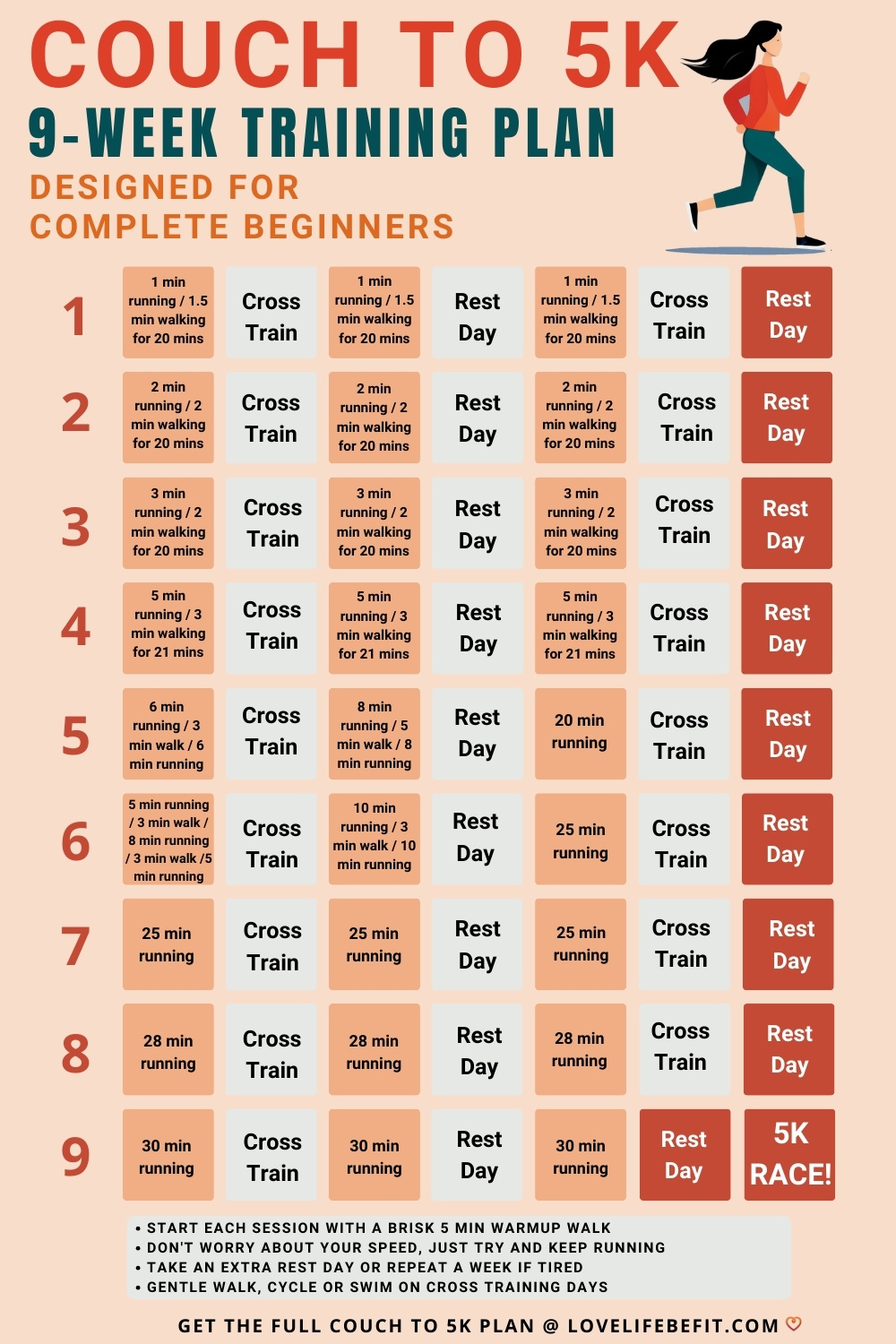
It’s almost impossible to find the official Couch to 5K Program in print or online, so I’ve created my own version with a few improvements. Just print it out and get started.
Couch To 5K 9-Week Training Plan Printable
How Couch To 5K Works
Couch to 5K uses run/walk intervals. You’re slowly increasing the length of the running intervals and gradually shortening the walking intervals. Before you know it, you’re running further, and by the end of week 5, you’re running 20 minutes without stopping.
There are three running workouts a week, and the remaining days are rest days. It’s best to still be active on most of your rest days, but take at least one complete day of rest. Walking, cycling, or swimming are good active-rest-day activities. Anything that keeps you moving.
The schedule progresses from walk-run intervals for the first 6 weeks to running continuously for the last 3 weeks. By that stage, you’ll start to believe in yourself as a runner!
Does Couch To 5K Work For Everyone?
Just because this plan works for a lot of people, it doesn’t mean it’s going to be everything to everybody. It will depend on your current fitness level. Here are a few reasons why Couch to 5K may not work for you:
1. It’s Just Too Hard
The great strength of the popular Couch To 5K Program is its gradual build-up but you’re still launching into running in the first week. Those intervals of 60 seconds run, 90 seconds walk will just be too hard for some people.
If you’re carrying a lot of extra weight or you haven’t exercised in years, don’t try to run. It’s just a shortcut to being disillusioned, or injured, or both. There’s a saying don’t run before you can walk and it definitely applies to Couch to 5K! Instead, start off with our Couch to 5K Walking Plan. When you can walk for 20 minutes at a brisk pace, you’re ready to start running.
2. The Build Up Is Too Fast
If you haven’t exercised in a long time, it’s better to take a couple of weeks to prepare before starting the Couch to 5K Program. Go out for fast-paced walks and try a little easy running for just a minute at a time. That way, when you start the program, it won’t be such a shock to your body.
When you do start the Couch to 5K program, be prepared to repeat weeks if necessary. The program should be doable, not demoralizing. If you find a session is too hard, drop back a week or switch out some of the run sections for walking.
There isn’t a one-size-fits-all solution when it comes to running. As long as you’re making progress, running further or faster, feel free to adapt the program. The amount of time it takes to complete Couch to 5K is up to you: 9 weeks or 12 plus weeks. It doesn’t matter. Complete the plan at your own pace. The aim is to get fitter and build a lifelong exercise habit.
3. It’s Just Too Easy
Yes, you read that right. It may not be fair, but not everyone’s starting at the same fitness level. Some people will find Couch to 5K too easy – especially if they’ve run in the past, walk regularly, or complete other types of fitness workouts.
One solution is to skip ahead with the program or find a more demanding training plan. Try following our Couch to 5K in 6 weeks plan below. Or if you want a big challenge, follow our Couch to Half Marathon plan.
4. You Don’t Lose Any Weight
Many beginner runners start with the goal of losing weight. Some of them fall in love with running and keep it up anyway, some lose weight, and for some, weight loss just doesn’t happen.
Surely everyone should lose weight from running? Sadly no. The problem is that exercise is only one part of the equation. If you want to lose weight, you have to watch your diet. You need to run 35 miles to burn just one pound of fat. Even by week 9, the plan is only 90 minutes of running per week. For most beginners, that’s less than 9 miles.
There are many factors at play here: your starting weight, sex, age, and metabolism. Couch to 5K will help you lose weight, but you still need to control your calorie intake and follow a healthy diet.
Unless you have a very high metabolism – think growing teenager – you can’t eat everything in sight and expect to lose weight. This is a problem because running can make you really hungry!
You can read more about how to lose weight from running, but the best advice is:
- Hydrate fully after your run
- Swap sugary treats and high-fat foods for lean protein, whole grains, fresh vegetables and fruit.
5. It’s Not Varied Enough
The last 3 weeks of Couch to 5K are just steady running. The distances get slightly further, but you’re not varying your training. Maybe you’re running these sessions harder and faster, but I suspect most runners are just running at a steady, slow pace.
This will help you build a running base, but it’s good to keep improving by adding one harder session a week. A fartlek session is ideal: fartlek is the Swedish word for speed play. Think of it as free-form interval training where you run harder for a minute or two, then back off to an easier pace. Keep repeating, tuning into your body to know when to push and when to ease up.
Try making one of your weekly runs a fartlek session in those last three weeks of the Program. It’s a good way to up the intensity and makes sure your running is still improving.
6. There Are No Strength Sessions
Building strength is important to avoid injury when you’re a beginner runner. It’s also a shortcut to getting the body you’ve always wanted. These essential strength exercises work well. Yoga for runners is also a great way to build strength and avoid muscle imbalance. Try to make time for at least one strength session every week, and you’ll soon start to see the benefits.
Couch To 5K in 6 Weeks Plan
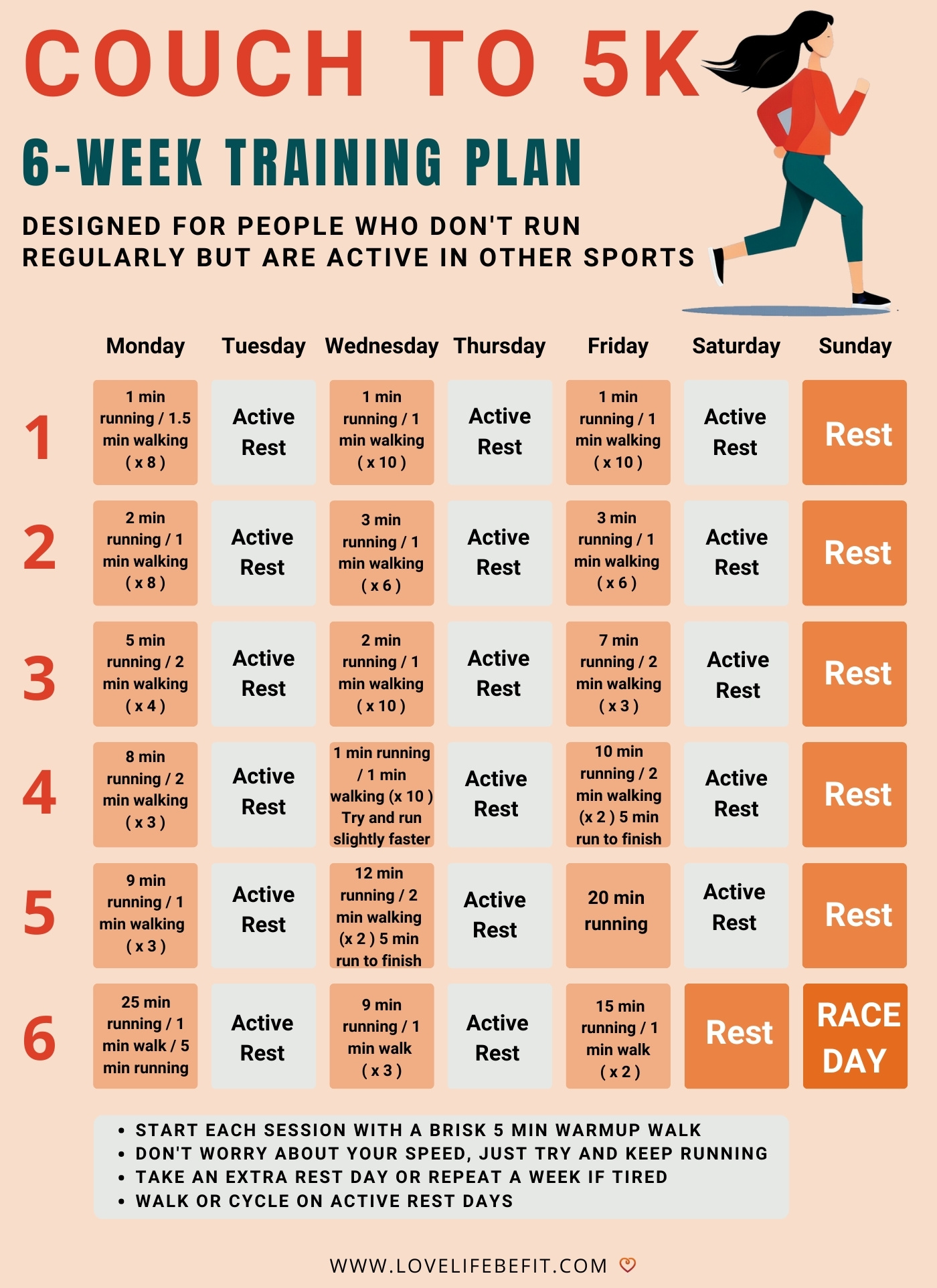
There are various training plans for Couch to 5K. This is my suggestion for going from Couch to 5K in 6 weeks. I’ve included it for people with a history of running or for those who are active in other sports and feel the original plan is too slow. It could also work for runners returning to fitness after an injury layoff.
To keep things easy and so that the only equipment you need is a watch (and a good pair of running shoes), this 6 Week 5K Training Plan is based on time spent exercising rather than distance. Most new runners will take 30 to 40 minutes for a 5K, so this training plan is based on building up to running continuously for 30 minutes.
As a rule of thumb, most people can complete races 2.5 times as long as their regular training run. So if you’re finding it relatively easy to run for 12-15 minutes plus by the end of the 6 weeks, you should manage to complete a 5K race without stopping.
Each training session starts with a 5-minute warmup walk for the first week. After the first week, you may feel able to break into an easy run during your 5-minute warmup.
Week 1
- Day 1: Brisk five-minute warmup walk, then do 8 repetitions of the following: 60 seconds of running, 90 seconds of walking.
- Day 2: Active rest. Make sure you walk during the day or cross-train.
- Day 3: Brisk five-minute warmup walk, then do 10 repetitions of the following: 60 seconds of running, 60 seconds of walking.
- Day 4: Active rest.
- Day 5: Brisk five-minute warmup walk, then do 10 repetitions of the following: 60 seconds of running, 60 seconds of walking.
- Day 6: Active rest.
- Day 7: REST.
Week 2
- Day 1: Warm-up for five minutes, then do 8 repetitions of 2 minutes running, 1 minute walking.
- Day 2: Active rest.
- Day 3: Warm-up for five minutes, then do 6 repetitions of 3 minutes running, 1 minute walking.
- Day 4: Active rest.
- Day 5: Warm-up for five minutes, then do 6 repetitions of 3 minutes running, 1 minute walking.
- Day 6: Active rest.
- Day 7: REST.
Week 3
- Day 1: Warm-up for five minutes, then do 4 repetitions of 5 minutes running, 2 minutes walking.
- Day 2: Active rest.
- Day 3: Warm-up for five minutes, then do 10 repetitions of 2 minutes running, 1 minute walking.
- Day 4: Active rest.
- Day 5: Warm-up for five minutes, then do 3 repetitions of 7 minutes running, 2 minutes walking.
- Day 6: Active rest.
- Day 7: REST.
Week 4
- Day 1: Warm-up for five minutes, then do 3 repetitions of 8 minutes running, 2 minutes walking.
- Day 2: Active rest.
- Day 3: Warm-up for five minutes, then do 10 repetitions of 1 minute running, 1 minute walking. Try and run at a slightly faster pace.
- Day 4: Active rest.
- Day 5: Warm-up for five minutes, then do 2 repetitions of 10 minutes running, 2 minutes walking. Finish with 5 minutes running.
- Day 6: Active rest.
- Day 7: REST.
Week 5
- Day 1: Warm-up for five minutes, then do 3 repetitions of 9 minutes running, 1 minute walking.
- Day 2: Active rest.
- Day 3: Warm-up for five minutes, then do 2 repetitions of 12 minutes running, 2 minutes walking. Finish with 5 minutes running.
- Day 4: Active rest.
- Day 5: Warm-up for five minutes, then run continuously for 20 minutes.
- Day 6: Active rest.
- Day 7: REST.
Week 6
- Day 1: Warm-up five minutes, then run continuously for 25 minutes. Walk for 1 minute. Finish with 5 minutes running.
- Day 2: Active rest.
- Day 3: Warm-up five minutes, then do 3 repetitions of 9 minutes running, 1 minute walking.
- Day 4: Active rest.
- Day 5: Warm-up five minutes, then do 2 repetitions of 15 minutes running, 1 minute walking.
- Day 6: REST.
- Day 7: 5K RACE!
On race day, you’ll be all fired up and should be able to run for at least 20 minutes without taking a break. Most people will manage to get to the end of the race without stopping, but there’s no shame in taking a walking break if you need one.
A Few Other Things You Need To Think About
Before you launch into your fitness journey, here are a few pitfalls you need to avoid:
1. Getting Injured
There’s always a high risk of injury for beginning runners. Most injuries, such as shin splints and plantar fasciitis are from doing too much too soon. So try not to get carried away. For absolute beginners, less is more.
If you’re a complete couch potato with no history of exercising, take the full nine weeks or longer to complete the program. Even if you’re already fit but new to running, don’t suddenly sign up for a half marathon. Build your training slowly!
2. Running Form
Learning how to run properly can help runners avoid injury. Landing with your feet under your body instead of overstriding, maintaining a good cadence, and keeping upright can make a big difference to how you run. Find out more about running form.
3. Running Gear
You don’t need a lot of equipment to go running, but it’s essential to invest in some good running shoes and most people prefer to run in specific running clothing. If you’re overweight, you may need shoes with extra support.
4. Giving Up Because Running Feels Too Hard
I’m a great believer in finding a fitness activity you enjoy. Just because I love running doesn’t mean you will. However, I don’t think you should give up before giving running a proper try. Follow these Couch to 5K tips to help you breathe while running and make running feel easier.
What Comes Next After Couch To 5K?
Hopefully, Couch to 5K will make you fall in love with running, and you’ll feel the benefits of following a healthy lifestyle. To enjoy going for a good run. And at the end of the program, aim to complete your first 5K race. It’s a great goal to aim for. Find a local fun run or road race with lots of fellow beginner runners and friendly support to cheer you across the finish line.
It’s fun and exciting to be running with other people and you’ll feel a terrific sense of achievement. Once you’ve got your first medal around your neck, what happens next?
Parkrun is a fantastic movement that started in the UK, providing free-to-enter timed 5K runs. They take place every Saturday morning and there’s now an event in almost every town throughout the UK. It’s a great way to keep up your newfound enthusiasm for running. The Parkrun movement is spreading worldwide with a rapidly growing number of US locations. Find out if there’s a venue near you.
Couch to 5K is just the first step on your running journey. As soon as you’ve completed your first 5K race, set your next fitness goal. Keep up your fitness momentum! Find a running club or group of friends and set new challenges. You can start training for a 10K, a half-marathon, or work on your running speed.